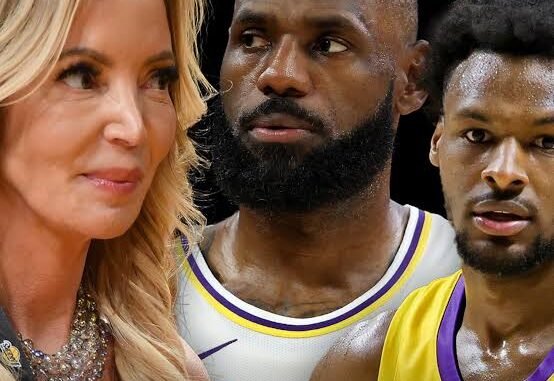
Jeanie Buss Pushes Back Strongly on LeBron James Report After Bronny Draft: “That Narrative Is Simply Not True”
Los Angeles Lakers governor Jeanie Buss has firmly denied a report suggesting she felt LeBron James was not grateful enough after the franchise selected his son, Bronny James, in the NBA Draft. The claim, which quickly spread across social media and sparked heated debate among fans and analysts, touched a nerve in the basketball world, intertwining family, legacy, power dynamics, and the unique relationship between the Lakers and one of the greatest players in NBA history.
According to the report, Buss was allegedly disappointed by what she perceived as a lack of public appreciation from LeBron following the Lakers’ decision to draft Bronny, a move widely seen as historic. The idea that the organization went out of its way to fulfill LeBron’s long-stated dream of playing alongside his son, only to feel underappreciated afterward, instantly fueled speculation about behind-the-scenes tension. Buss, however, moved quickly to shut that narrative down.
Speaking through team-aligned sources and in private conversations that later became public, Buss made it clear that there is no resentment, no bitterness, and no regret surrounding the decision. In her view, the report mischaracterized both her personal feelings and the Lakers’ organizational philosophy. Drafting Bronny, she insists, was not a favor, a symbolic gesture, or a transaction rooted in obligation. It was a basketball decision made within the broader vision of the franchise.
The selection of Bronny James was always going to be controversial. As the son of LeBron James, arguably the most influential player in league history, Bronny entered the draft under a microscope unlike almost any late-second-round prospect before him. Supporters pointed to his defensive instincts, basketball IQ, and potential upside in a developmental system. Critics, meanwhile, questioned whether his name carried more weight than his résumé. The Lakers, caught in the middle, knew that any decision involving Bronny would be interpreted through the lens of LeBron’s legacy.
For Jeanie Buss, that scrutiny is nothing new. As the steward of one of the most iconic franchises in sports, she has spent years navigating public pressure, internal expectations, and the constant demand to win now while honoring the Lakers’ long-term identity. Her relationship with LeBron has been central to that balancing act. Since his arrival in 2018, LeBron has helped deliver a championship, restore relevance, and elevate the Lakers’ global profile. At the same time, his presence has often come with assumptions that he wields outsized influence over roster decisions.
The report suggesting Buss felt LeBron was not grateful enough played directly into that narrative. It implied a transactional relationship, one where goodwill needed to be publicly acknowledged and where drafting Bronny was seen as a personal concession rather than a team move. Buss’ denial aims to dismantle that idea entirely. From her perspective, the Lakers did not draft Bronny to appease LeBron, nor did they expect gratitude in return. The organization evaluated a player, saw value, and made a choice consistent with its goals.
Those close to the Lakers point out that Buss has long believed in treating players and their families with respect, without turning those relationships into leverage. In that sense, drafting Bronny fits into a broader Lakers tradition of embracing legacy, continuity, and storytelling, elements that have always been part of the franchise’s DNA. From Magic Johnson to Kobe Bryant, the Lakers have never shied away from the emotional and symbolic side of basketball, as long as it aligns with competitiveness.
LeBron’s response, or perceived lack of one, also deserves context. Throughout his career, LeBron has often chosen his words carefully, particularly when family is involved. His pride in Bronny has been evident for years, expressed through social media posts, interviews, and courtside reactions long before the draft. Expecting a specific type of public gratitude immediately after draft night may say more about media expectations than about LeBron’s actual feelings toward the organization.
Buss’ denial also serves a strategic purpose. Any suggestion of friction between the Lakers’ ownership and LeBron inevitably raises questions about the future. With LeBron entering the twilight of his career, every comment, rumor, or leaked sentiment is magnified and interpreted as a signal. By firmly rejecting the report, Buss sends a message of stability, unity, and mutual respect at a time when uncertainty is the last thing the franchise needs.
Inside the Lakers’ front office, the message has reportedly been consistent. Bronny’s development will be handled patiently, without shortcuts or special treatment. He will earn minutes the same way any young player does, through practice habits, defensive effort, and growth. That approach, the team believes, protects both Bronny and the organization from the perception that the pick was purely symbolic.
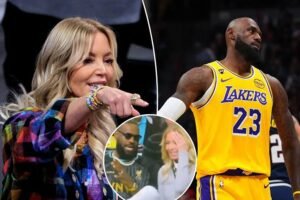
For fans, the episode highlights the complicated reality of modern superstar dynamics. LeBron James is not just a player; he is a brand, a legacy, and a cultural force. Any decision connected to him reverberates far beyond the court. Jeanie Buss, for her part, occupies a similarly symbolic role, representing continuity with the Lakers’ past while guiding its future. When narratives arise suggesting tension between those two figures, they take on outsized importance.
Ultimately, Buss’ response reframes the conversation. Rather than focusing on gratitude or perceived slights, she emphasizes alignment. The Lakers believe they made a smart decision. LeBron believes in his son. Bronny gets an opportunity to develop within one of the most visible franchises in sports. From that perspective, there is no conflict, only convergence.
Whether the public fully accepts that explanation remains to be seen. The NBA thrives on storylines, and the James family’s journey is one of the most compelling the league has ever seen. Still, Jeanie Buss’ firm denial draws a clear line. The Lakers are not operating from emotion or obligation. They are operating from belief in their process.
In a league where rumors often take on a life of their own, Buss’ stance is a reminder that not every headline reflects reality. Sometimes, the loudest narratives are the least accurate. For now, the Lakers move forward, LeBron continues his pursuit of longevity and legacy, and Bronny begins his professional journey under the brightest lights imaginable, with no debt of gratitude required.
Leave a Reply