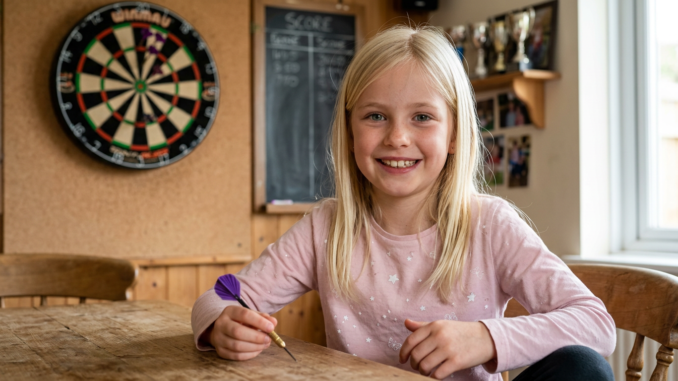
From Backyard Dreams to Global Fame: The Untold Childhood Story of Fallon Sherrock Will Leave You Stunned
There’s something almost poetic about the way greatness begins. Not with roaring crowds or flashing lights, but in quiet, ordinary places—backyards, living rooms, and local pubs where dreams are still fragile and unspoken. For Fallon Sherrock, long before the history-making moments and global recognition, there was simply a young girl, a dartboard, and a spark that refused to fade.
Born in Milton Keynes, Fallon’s childhood wasn’t wrapped in luxury or privilege. It was grounded, real, and shaped by the everyday rhythm of a working-class family. But within that ordinary setting, something extraordinary was quietly taking root. While most children her age were exploring typical hobbies, Fallon found herself drawn to a game that many still associated almost entirely with men. Darts wasn’t just a pastime in her home—it was a language, a connection, and eventually, a calling.

Her introduction to the sport came early, influenced heavily by family. The dartboard wasn’t some distant object reserved for adults; it was part of her environment. Watching games, observing technique, and eventually stepping up to throw her own darts, Fallon began developing not just skill, but confidence. At an age when most children are still figuring out what they enjoy, she had already found something that felt instinctively right.
What made her journey unique wasn’t just her talent—it was the environment she had to grow in. Darts, as a sport, carried a strong masculine identity. Young Fallon wasn’t just learning how to aim and score; she was learning how to belong in a space where she wasn’t always expected. That kind of challenge can either discourage or define a person. In Fallon’s case, it did the latter.
Her early years were filled with small but meaningful moments. Practicing for hours, adjusting her stance, learning the subtle mechanics of grip and release—these weren’t glamorous scenes. There were no cameras, no headlines. Just repetition, patience, and a quiet determination that would later become her trademark. Every missed shot became a lesson. Every small improvement became motivation.
School life ran alongside this growing passion, but darts was never far from her mind. While others dreamed of conventional futures, Fallon’s ambitions were slowly taking a different shape. It wasn’t necessarily about fame or recognition at that stage. It was about mastering something she loved, something that made her feel alive. There’s a purity in that kind of ambition—one that isn’t driven by external validation, but by internal satisfaction.
Of course, the path wasn’t without its struggles. Growing up, there were moments of doubt, moments when the idea of making a career out of darts must have seemed distant, even unrealistic. Financial limitations, societal expectations, and the lack of visible female role models in the sport all posed quiet challenges. But what Fallon had—what truly set her apart—was resilience.
Her family played a crucial role in nurturing her talent. Support doesn’t always come in grand gestures; sometimes it’s as simple as encouragement, belief, and the willingness to let a child pursue something unconventional. That support became the foundation on which Fallon built her confidence. It told her that her passion mattered, even if the world hadn’t fully recognized it yet.
As she grew older, the game grew with her. What started as a childhood interest slowly evolved into something more serious. Local competitions became stepping stones. Each match added a layer of experience, sharpening not just her technical ability, but her mental strength. Darts, after all, is as much a psychological game as it is a physical one. The ability to stay calm under pressure, to focus when it matters most—these are traits that aren’t developed overnight. They are built over years, often beginning in those quiet, unnoticed moments of youth.
Fallon’s childhood also shaped her personality in ways that would later define her public image. There’s a groundedness to her, a sense of authenticity that fans connect with. She doesn’t carry the aura of someone who was handed success. Instead, she reflects the journey of someone who earned it—step by step, throw by throw.
Looking back, it’s easy to connect the dots. The young girl practicing in Milton Keynes, the teenager competing in local tournaments, the determined individual refusing to be boxed in by expectations—all of these versions of Fallon Sherrock were part of the same story. A story that would eventually break barriers and challenge perceptions on a global stage.
But what makes her childhood story truly compelling isn’t just where it led—it’s how relatable it is. It reminds us that greatness doesn’t always announce itself early. Sometimes, it grows quietly, shaped by persistence, nurtured by support, and driven by an inner belief that refuses to be silenced.
There’s also something powerful about the idea of representation. Fallon didn’t grow up with many examples of women dominating in darts. In many ways, she had to imagine a path that wasn’t clearly visible. That kind of imagination requires courage. It requires the willingness to step into the unknown and carve out space where there wasn’t much before.
Her journey from a young girl with a dartboard to a global name isn’t just about personal success—it’s about changing narratives. It’s about proving that talent doesn’t belong to a specific gender, that passion doesn’t need permission, and that dreams, no matter how unconventional, are worth pursuing.
Even now, when people look at Fallon Sherrock, they see the achievements, the headlines, the history. But behind all of that is a childhood filled with quiet determination and unseen effort. A childhood that didn’t guarantee success, but made it possible.
And maybe that’s what makes her story so inspiring. Not the idea that success is inevitable, but the reminder that it’s achievable. That somewhere, in a small room or a backyard, there could be another young dreamer, picking up a dart, unaware of just how far it might take them.
Fallon’s story tells us that beginnings matter—but they don’t have to be perfect. They just have to be real.
Leave a Reply