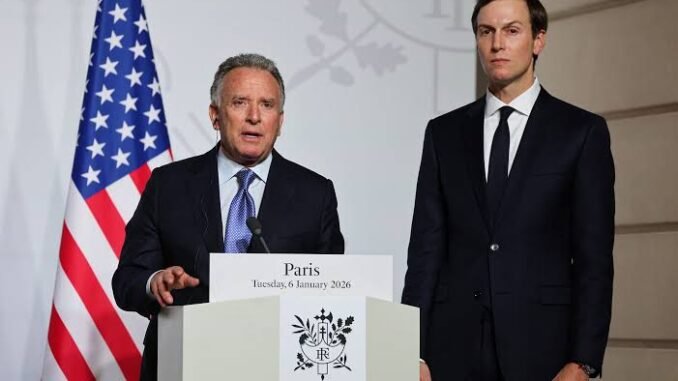
The decision by Steve Witkoff and Jared Kushner to travel to Pakistan for renewed discussions involving Iran represents far more than a routine diplomatic engagement. It is a moment shaped by urgency, uncertainty, and the weight of a geopolitical crisis that has been steadily intensifying. What is unfolding is not just another round of talks, but a delicate attempt to prevent a fragile situation from unraveling into something far more dangerous.
At its core, this mission reflects how strained relations between United States and Iran have become. For months, tensions have been escalating across multiple fronts—military, economic, and political. Each side has tested the limits of the other, engaging in calculated moves that signal strength while avoiding outright war. Yet, despite these efforts to manage the confrontation, the margin for error has continued to shrink.
The recent ceasefire, fragile as it is, has created a narrow opening for diplomacy. It is within this space that Witkoff and Kushner now step, carrying the expectations of a government that is clearly searching for a way to stabilize the situation without further escalation. The ceasefire itself was never meant to be a permanent solution. It was, instead, a pause—a chance to determine whether dialogue could succeed where pressure and confrontation have struggled.
Choosing Pakistan as the location for these talks is no coincidence. Over time, the country has positioned itself as a critical intermediary in complex international disputes. Its ability to maintain working relationships with both Washington and Tehran has made it a valuable bridge at a time when direct communication between the two sides is often strained or politically sensitive. Hosting such high-level discussions places Pakistan at the center of a diplomatic effort that could influence the direction of an entire region.
The absence of more traditional diplomatic formats in favor of this quieter, more controlled engagement suggests a shift in strategy. Rather than conducting highly public negotiations that invite scrutiny and pressure, the current approach appears designed to allow more flexibility. By sending envoys instead of top-tier political leadership, the United States may be attempting to lower the stakes publicly while keeping the substance of the discussions serious and focused.
Steve Witkoff brings a reputation for navigating complex negotiations, often operating in high-pressure environments where outcomes are uncertain. His presence signals that the United States is taking the talks seriously from a diplomatic standpoint. Jared Kushner’s involvement, however, adds a different layer to the mission. As someone closely tied to the inner workings of American political strategy, his role suggests that these discussions are not just about policy, but about broader strategic positioning.
This combination of personalities reflects a dual approach: one grounded in negotiation experience, the other in political calculation. It highlights the reality that modern diplomacy is rarely just about resolving disputes. It is also about managing perception, maintaining influence, and shaping narratives both at home and abroad.
On the Iranian side, the situation is equally complex. Tehran has consistently maintained firm positions on key issues, particularly regarding its sovereignty and its right to pursue its own strategic and technological ambitions. At the same time, it faces significant economic pressure and regional challenges that make prolonged instability costly. Engaging in talks, therefore, becomes both a necessity and a risk.
One of the most difficult aspects of this diplomatic effort lies in the gap between what each side wants and what each side is willing to concede. For the United States, concerns about Iran’s nuclear ambitions, regional influence, and security implications remain central. For Iran, issues of economic relief, political independence, and recognition of its regional role are equally non-negotiable.
These are not minor disagreements that can be easily smoothed over with incremental compromises. They are fundamental differences in perspective and priority. Previous attempts at negotiation have often faltered at this exact point, where progress requires one side to make a concession it is not politically or strategically prepared to make.
The broader regional context adds further pressure to the talks. The Middle East remains a highly sensitive geopolitical environment, where shifts in one relationship can trigger reactions across multiple countries. Allies and adversaries alike are watching closely, aware that any agreement—or failure to reach one—will have ripple effects beyond the immediate parties involved.
Economic considerations also loom large over the discussions. The stability of global energy markets is closely tied to developments in this region, particularly in key transit areas that handle a significant portion of the world’s oil supply. Even minor disruptions can lead to major fluctuations in prices, affecting economies far beyond the Middle East. This creates an additional layer of urgency, as prolonged uncertainty is something the global system can ill afford.
Despite all these challenges, there are reasons why both sides might see value in continuing to engage. For the United States, avoiding a deeper conflict while maintaining strategic pressure is a delicate balancing act. For Iran, navigating external pressure while preserving internal stability requires careful decision-making. Diplomacy, even when difficult, offers a path that avoids the immediate costs of escalation.
Yet, skepticism remains. Conflicting signals from both sides have made it difficult to determine how committed each party truly is to reaching an agreement. Public statements often emphasize strength and resolve, while behind-the-scenes discussions may reveal a more nuanced reality. This disconnect between rhetoric and action is a hallmark of high-stakes diplomacy, where appearances can be just as important as outcomes.
Security around the talks themselves reflects the sensitivity of the situation. High-level meetings of this nature carry inherent risks, not only because of the individuals involved but because of what they represent. Ensuring a controlled environment is essential to allowing meaningful discussions to take place.
Another important dimension is the role of other international actors. While the talks may be centered on the United States and Iran, they do not occur in isolation. Other countries, particularly those with strong ties to the region, have an interest in the outcome and may influence the process in subtle but significant ways. Diplomacy at this level often involves multiple layers of communication, some visible and others entirely behind the scenes.
As the envoys prepare to engage, expectations remain carefully measured. There is no clear indication that a breakthrough is imminent, nor is there an assumption that the talks will fail outright. Instead, the prevailing sense is one of cautious possibility. Progress, if it comes, is likely to be incremental rather than dramatic.
What makes this moment particularly significant is the convergence of pressure and opportunity. The existing ceasefire provides a temporary framework for dialogue, but it is not a permanent safeguard against escalation. Without meaningful progress, the risk of returning to confrontation remains high. This creates a window—narrow but critical—in which diplomacy must either deliver results or give way to other, less predictable developments.
For observers around the world, these talks represent more than just another diplomatic meeting. They are a test of whether dialogue can still play a meaningful role in resolving deeply entrenched conflicts. In an era where geopolitical tensions often seem to escalate faster than they can be resolved, the outcome of this engagement will carry symbolic as well as practical significance.
As discussions begin, the focus will not only be on what is said, but on what is possible. Can two sides with fundamentally different visions find even a small area of agreement? Can trust, even at a minimal level, be established or restored? And perhaps most importantly, can this moment be used to build a foundation for something more stable in the future?
There are no easy answers to these questions. What is clear, however, is that the stakes are high, the challenges are real, and the consequences of failure are significant. Whether this effort leads to progress or simply becomes another chapter in a long history of difficult negotiations will depend on decisions made in quiet rooms, far from public view, but with global implications.
In the end, the journey of Witkoff and Kushner to Pakistan is not just about diplomacy. It is about timing, strategy, and the enduring hope that even in the most complicated situations, there remains a path—however uncertain—toward understanding and stability.
Leave a Reply